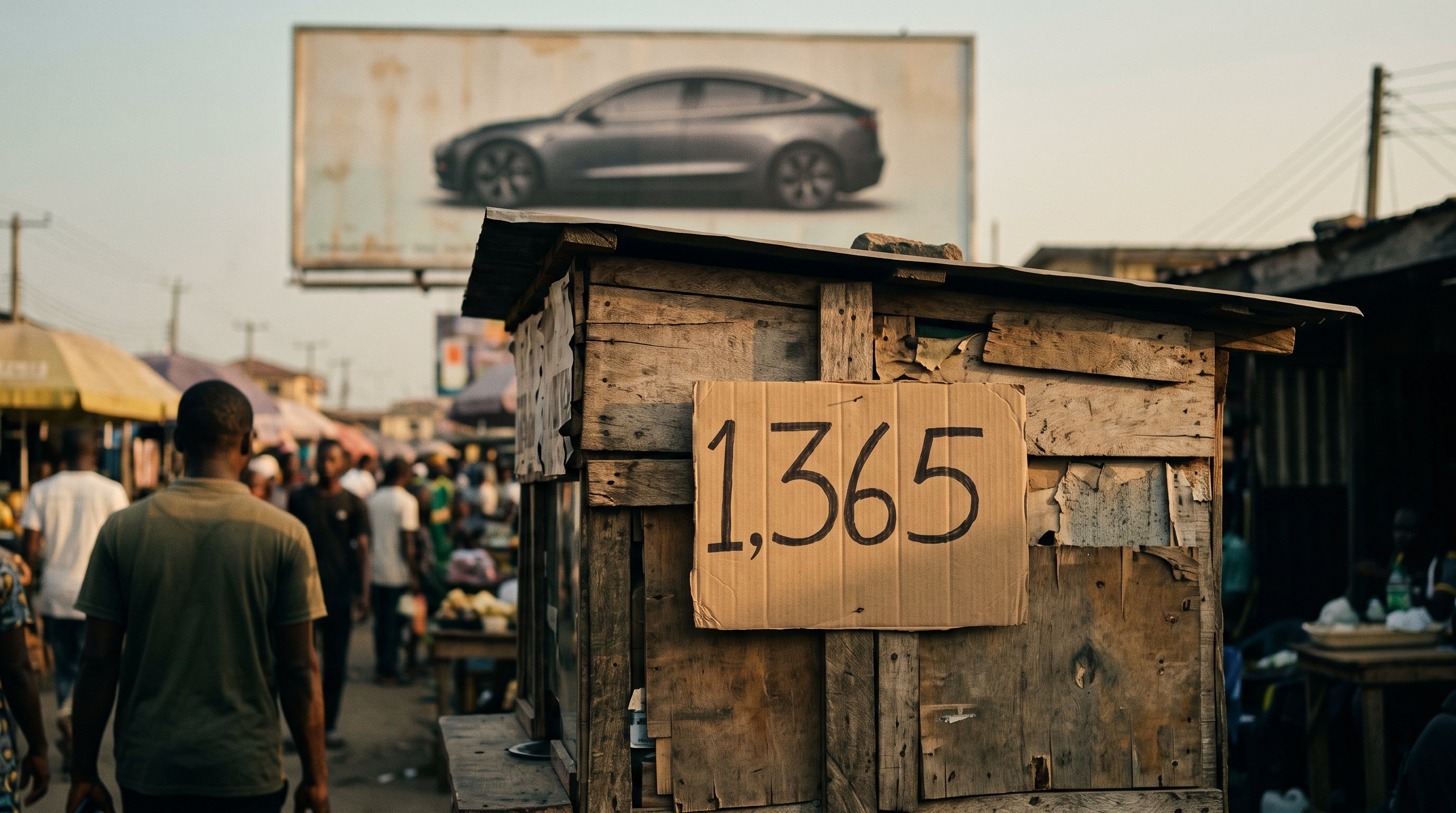
Every Nigerian kitchen has the tin. Milo on a Saturday morning, Maggi in the pot, Golden Morn before school. These are not imported luxuries. They are made in Agbara and Flowergate, by a company ordinary Nigerians have part-owned for nearly half a century. On 20 April 1979, Nestle Nigeria listed on the Nigerian Stock Exchange, one of the companies the indigenization decrees of the 1970s pushed into local hands. For decades it did what a blue chip is supposed to do: it sold more each year and it paid its shareholders.
Then the currency it reported in fell out from under it.
What broke was the balance sheet, not the business.
Earning in naira, owing in dollars
Nestle Nigeria sells to Nigerians, so its revenue arrives in naira. But for years, when it needed machinery and raw materials it could not source locally, it borrowed from its parent, Nestle SA, in dollars. That is a mismatch: income in one currency, debt in another. As long as the naira held roughly steady, the mismatch was manageable.
In June 2023 the naira was allowed to float, and it lost more than half its value against the dollar within the year. Nestle's dollar loans did not change in dollars. Revalued into naira at the 2023 closing rate of about 907 to the dollar, they ballooned. The company reported a foreign exchange loss of 195 billion naira for 2023, and a net loss of 79.4 billion naira against a 49 billion naira profit the year before. Shareholders' funds, the accounting measure of what owners would be left with if everything were sold and every debt paid, went to negative 78 billion naira. Nestle owed more than everything it owned.
What negative equity actually means
Negative equity does not mean the factory gates shut. Milo still sold. Revenue in fact grew 22 percent in 2023 to 547 billion naira, because Nigerians still bought food. What broke was the balance sheet, not the business. But the balance sheet carried a hard rule: a company with negative retained earnings cannot lawfully pay a dividend. The quiet dividend decades stopped.
The hole then got deeper before it got shallower. In 2024 the naira slid again, finance costs swelled to 392.8 billion naira, and the net loss widened to 164.6 billion naira. Accumulated losses reached 243 billion naira and shareholders' funds fell to negative 92.3 billion naira. Nestle plugged part of the equity gap not by raising new cash but by revaluing its land and factories, a 150 billion naira accounting gain. That fixed the top of the balance sheet. It could not fix retained earnings, and so it could not restore the dividend.
The repair, in order
The recovery, when it came, was sequenced. First the operations: revenue climbed 75 percent in 2024 to 958.8 billion naira as the company pushed prices through, and the final quarter of that year returned to profit. Then the debt: Nestle began paying down the dollar loans, making an early repayment of 40 million dollars. Then, in 2025, the turn completed. Revenue crossed one trillion naira for the first time, reaching 1.2 trillion. Net finance costs collapsed from 389.5 billion to 58.5 billion naira as the currency steadied and the debt shrank. The company reported a net profit of 105 billion naira and total equity returned to a positive 12.9 billion naira.
What has not returned is the dividend. Management said plainly in February 2026 that it would resume payments only once the negative retained earnings, still 112.8 billion naira at the end of 2025, are eliminated by future profits. The repair is real but unfinished.
What a 47-year survivor teaches
None of this is an argument about whether Nestle is a good or bad share to hold, and this piece takes no position on that. The lesson is structural. A company can sell more every year, raise prices successfully, dominate its market, and still have its owners' stake wiped to below zero, not by anything it sold, but by the gap between the currency it earns and the currency it owes. That gap is the quiet risk inside any Nigerian company with foreign debt, and it does not appear on the Maggi cube.
It is also why the video this piece accompanies spends time on funds as well as single shares. A single blue chip can carry a whole household's confidence for decades and still break on a currency it does not control. Spreading money across many companies does not remove that risk, but it means no single mismatched balance sheet gets to decide the outcome on its own.
Sources
9 sources
- Nestle Nigeria company history and 20 April 1979 listing. Nestle Nigeria 2023 Annual Report 2023 Annual Report. Commenced trading 1961; became publicly listed on the Nigerian Stock Exchange on 20 April 1979; Agbara factory commissioned 1982. Accessed 5 Oct 2026.
- Nestle Nigeria company profile (listing under indigenization, brand history). Wikipedia, citing company records Began trading on the NSE in 1979 following an indigenization promotion decree; Maggi packaging plant 1971, Agbara land leased 1978. Accessed 5 Oct 2026.
- Nestle Nigeria reports N104 billion loss in 2023, shareholders funds wiped out. Nairametrics 28 Feb 2024. 2023: FX loss N195bn; net loss N79.4bn vs N49bn profit in 2022; shareholder funds negative N78bn from N30.2bn; revenue N547.1bn; about $362.25m drawn in foreign currency loans from Nestle SA. Accessed 5 Oct 2026.
- 94% of our N195 billion FX losses are unrealized, Nestle. Nairametrics 18 Apr 2024. Loans revalued at the 2023 closing rate of N907.11/$; loans from parent Nestle SA since 2020 for raw materials and equipment amid FX scarcity. Accessed 5 Oct 2026.
- Nestle Nigeria clever move to reverse negative shareholder funds. Nairametrics 22 Apr 2024. Fixed assets revalued from N165.2bn to N305.4bn to plug negative equity; negative retained earnings still bar dividends. Accessed 5 Oct 2026.
- Nestle Nigeria reports N221.6 billion loss before tax in 2024, returns to profitability in Q4. Nairametrics 27 Feb 2025. FY2024: revenue N958.8bn (+75.25%); finance cost N392.8bn; loss after tax N164.6bn; shareholders' funds negative N92.29bn; Q4 2024 profit after tax N19.68bn. Accessed 5 Oct 2026.
- Nestle Nigeria's N164.6bn loss deepens equity hole. InsideBusiness 3 Mar 2025. Accumulated losses N243bn in 2024; net FX losses N290.7bn in 2024; no dividend proposed for 2024. Accessed 5 Oct 2026.
- Nestle Nigeria swings to profit after record N1.20trn revenue. Businessday 26 Feb 2026. FY2025: revenue N1.20 trillion (+26%); net income N104.97bn; net finance costs N58.5bn from N389.5bn; equity positive N12.9bn from negative N92.3bn; accumulated losses N112.8bn; no dividend for a second year. Accessed 5 Oct 2026.
- Nestle Nigeria rebounds to positive equity on N1.2tn sales. The Punch 26 Feb 2026. Early repayment of $40m forex-denominated debt; negative retained earnings cut 53.6% to N112.8bn; CEO says dividends resume once negative retained earnings are eliminated. Accessed 5 Oct 2026.
Spotted something wrong? Report a correction. Every fix is logged in the open corrections record.