Naira Journal
Official nowloading
Street nowloading
Checking the dated feed
The two nairas

One currency.
Two prices.

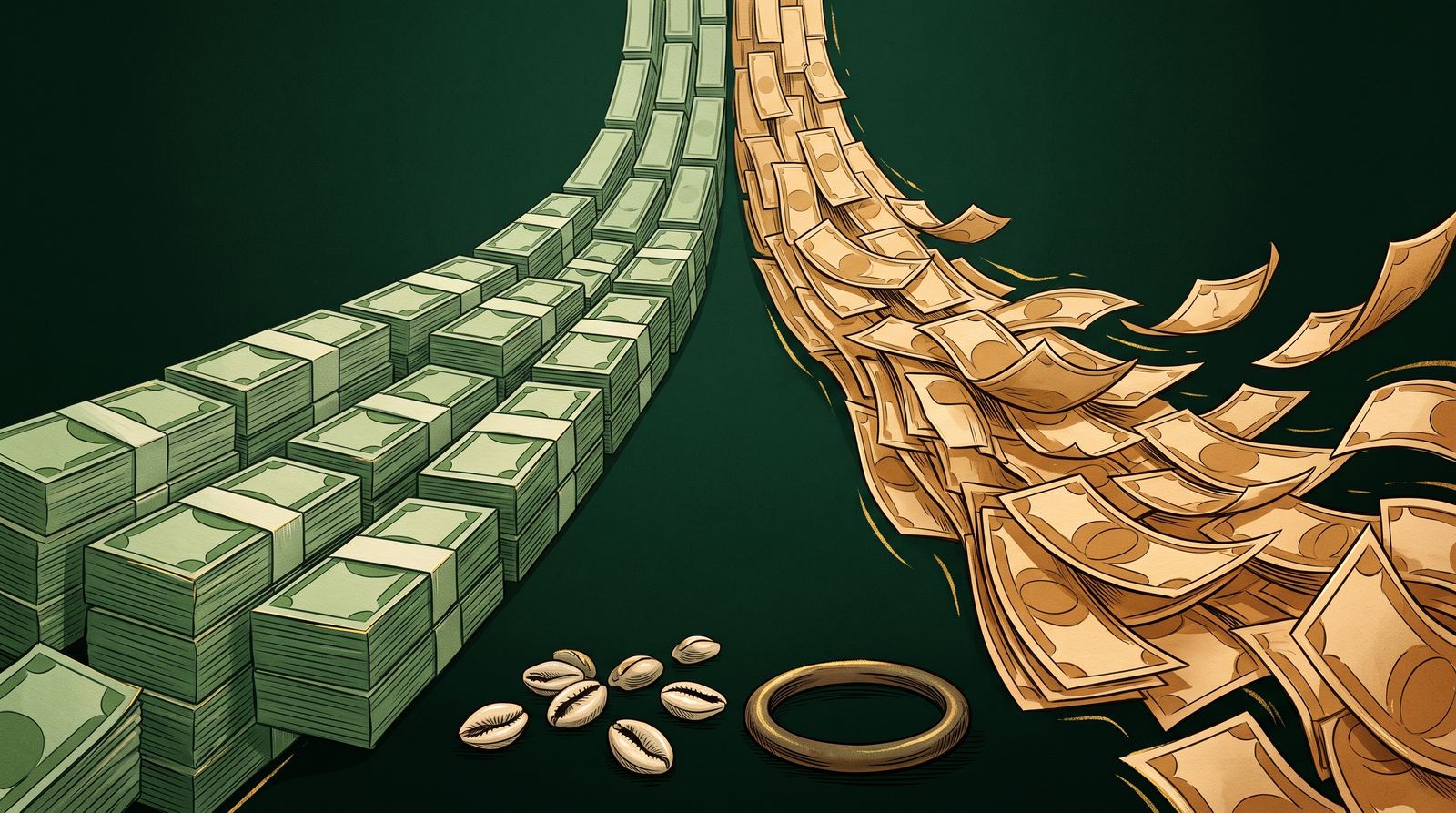
For most of living memory Nigeria has quoted the dollar twice: once at the official window, once on the street. The gap is not a rumour. It is a dated record.

This page does not draw a smooth line through history and call it a series. Each point is a published print, with its source underneath. Where only an annual average survives, the page says so. The live strip above is today, when the feed is fresh, and it goes blank rather than lie.

Research and education, not financial adviceSources checked 17 Aug 20268 dated prints

The record, as points

Official in green. Street in gold.

Tap a dot to jump to that year. The lines only connect prints that were actually published. They are a guide for the eye, not a claim that the rate walked a straight path in between.

11010020050010001985198619871994201520232023
OfficialStreet

Vertical scale is naira per US dollar. Early years sit near the floor on purpose: 0.89 and 664 cannot share a linear axis without the first decades collapsing to a speck.

The years

Eight prints that hold the story.

1985

Before the auction

Official

₦0.89

Street

₦3.79

Street premium

326%

One official naira, already two prices

A year before the Second-tier Foreign Exchange Market, the official rate sat at 0.89 naira to the dollar. The street was already at 3.79. The two nairas were not born in 2023. They were already here.

Where the record is thin

Both figures are annual averages, not a single day's print. The CBN table and the Penn series agree on the official 1985 level to two decimals. The street figure comes from the CBN table only.

26 Sep 1986

SFEM opens

Official

₦2.02

Street

₦4.17

Street premium

106%

The auction that split the official window

On 26 September 1986 the Central Bank discarded exchange control and opened the Second-tier Foreign Exchange Market. For a few months Nigeria ran two official rates at once: a first-tier rate for government bills, and an auction rate for everyone else.

Where the record is thin

The first auction print itself is not recovered here as a single tick. The 2.02 and 4.17 figures are the 1986 annual averages in the CBN bullion table, not the opening-day auction.

2 Jul 1987

The first merge

Official

₦3.74

Street

₦5.55

Street premium

48%

Two official windows become one

On 2 July 1987 the first-tier and second-tier official markets were merged into one Foreign Exchange Market. The CBN later recorded the convergence at 3.74 naira to the dollar. The street did not merge with them.

Where the record is thin

3.74 is the official merge print. 5.55 is the 1987 annual street average, not a 2 July street quote. A same-day street print for that date was not found.

1994

The re-peg

Official

₦21.89

Street

₦59.79

Street premium

173%

Official frozen, street walks away

In 1994 the official rate was pegged at 21.996 naira to the dollar. By year end the street premium had blown out past 350 percent. This is the year the two nairas stopped pretending to be neighbours.

Where the record is thin

350 percent is the CBN review's year-end premium. 173 percent is the premium implied by the annual averages in the bullion table. They measure different things. Both are shown, and neither is rounded into the other.

Nov 2015

The 197 peg

Official

₦197

Street

₦235

Street premium

19%

Held at 197, while the street printed 235

Through 2015 the Central Bank managed the interbank rate at about 197 naira to the dollar. In late November the street was trading around 235 to 240. The official window looked still. The other naira was not.

Where the record is thin

Street quotes that week sit in a band, about 235 to 240, not a single print. The chart uses the 235 figure from the 26 November Nairametrics report, which also restates the 197 peg on the same day.

14 Jun 2023

The float

Official

₦664.04

Street

₦755

Street premium

14%

One official window, a 40 percent drop

On 14 June 2023 the Central Bank collapsed every official window into the Investors and Exporters window and brought back willing-buyer, willing-seller trading. The I and E close that day was 664.04 naira to the dollar, down from about 462 the day before. The street, already near 755, barely moved.

Where the record is thin

Same-day street quotes that afternoon sit between about 753 and 768 depending on the desk. The chart uses 755, the THISDAY close. The 664.04 official close is the FMDQ figure, not the 750 official intraday low.

26 Sep 2023

A thousand on the street

Official

₦773.25

Street

₦1,000

Street premium

29%

The street hits 1,000. Official does not.

On 26 September 2023 Lagos street desks sold the dollar at 1,000 naira. The official I and E window had closed the previous session at 773.25. Three months after unification, the two nairas had walked apart again.

Where the record is thin

773.25 is the official close on 25 September, the last full official session cited next to the 26 September street print. A same-day official close for the 26th is not used here.

After June 2023

What the Fund measured

The gap compressed. It did not vanish.

An IMF Selected Issues paper published in 2026 found that the parallel premium, which had averaged about 30 percent before unification and topped 70 percent in the worst stretches, compressed to an average of about 9 percent after June 2023. Compression is not disappearance. The two nairas are still on the page.

Where the record is thin

Nine percent is an average after unification, not today's live spread. The live strip at the top of this page is the current reading, when the feed is fresh. This card is the Fund's measured average, not a forecast.

The rate on your receipt is the one that counts.

A US share, a school fee, a transfer home: each one clears at some naira price. The official print, the street print, and the price your app actually gives you are not the same number. This page is the dated record of the first two. The third is the one a person can check on a single trade, naira out divided by dollars in.

This page is research and education. It is not financial advice, and nothing here is a recommendation to buy, sell, or hold anything. Every figure carries its source above, checked on 17 Aug 2026. Where the record is an annual average rather than a day's print, or where desks disagree, the page says so. Live quotes come from the site's dated official and street feeds and disappear when they go stale.

The weekly brief

When the next piece is ready.

One email when a piece is ready, plus how the real account is doing. Not a list that fills your inbox. Unsubscribe in one click.

One step, no confirm email. The address is used only to send the newsletter, never shared or sold. More in the privacy note.