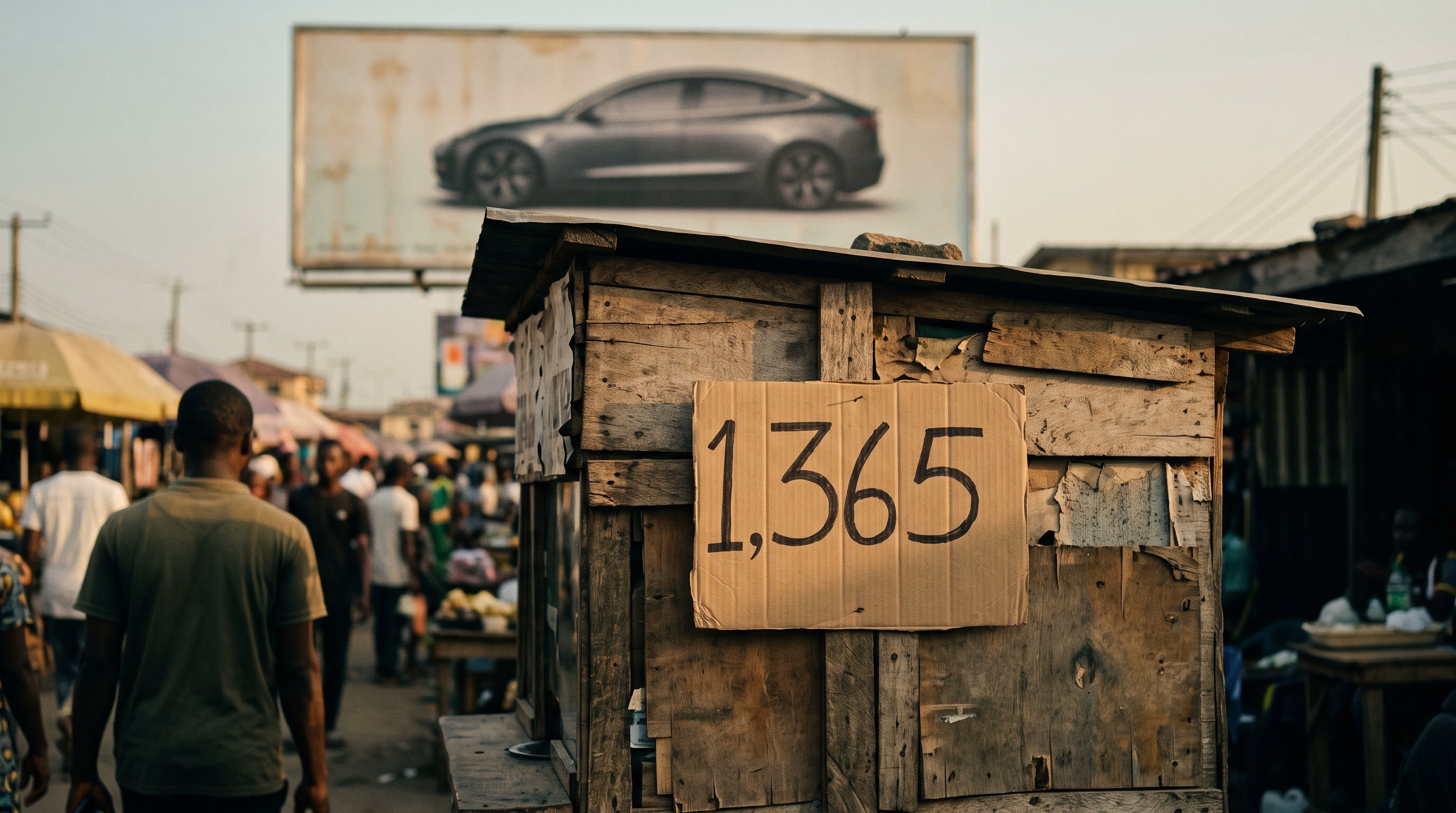
Long before a Nigerian ever bought a share, gold was how a family held its money across a bad decade. It sat in a wrapper, in a box, in a drawer that only one person opened. It was weighed at naming ceremonies and eyed at weddings. When the naira had a bad year, the gold in the box did not have a bad year, because nobody had priced it in naira to begin with. Our grandmothers were running a reserve strategy. They did not call it that, and they did not need a headline to tell them what it was worth. They weighed it.
The country runs the same strategy, at a different scale, and in March 2026 it produced a headline. The Central Bank announced that Nigeria's gold holdings had reached 3.5 billion dollars, a record, after taking delivery of a new batch of locally mined and refined bars. Vanguard, Punch and Nairametrics all carried it in the first week of March. Governors and ministers said the right words about diversification. And the number is real. But the number is not what most people reading that headline thought it was.
The ounces are the fact. The valuation is the weather.
Here is the part the headline does not say. Nigeria's gold reserve has been, in ounces, almost perfectly flat for a quarter of a century. The Central Bank's own audited accounts put the holding at 687,402 troy ounces, about 21.4 tonnes, at the end of 2022, the same as the year before. World Gold Council data built from IMF statistics shows the reserve averaging 21.37 tonnes across the entire period from 2000 to 2024, which is to say: a straight line. The country did not spend those years stacking. It held the same small pile, year after year, while oil came and went.
So where did a 3.5 billion dollar record come from? Arithmetic, mostly. The pile was worth about 1.25 billion dollars at the end of 2022, valued then at roughly 1,824 dollars an ounce. By the end of 2024 the same ounces were marked at 2,624 dollars and the holding read 2.77 trillion naira. At the end of 2025 the accounts showed 689,318 ounces valued at 4,319 dollars each, and the gold line had nearly tripled in naira terms in a single year. In January 2026 the world gold price hit its all-time high, 5,589 dollars an ounce, and the March announcement landed on top of that market. The record was the price. The bars barely moved.
None of this makes the record fake. It makes it a different kind of thing from what 'reserves hit a record' suggests. There is one genuinely new development inside it, and it matters more than the valuation: since 2020, through a programme now called the National Gold Purchase Programme, the Central Bank has started buying gold mined inside Nigeria, refined locally to the London Bullion Market Association's Good Delivery standard, and paying for it in naira. The March 2026 delivery came through that channel, aggregated by the Solid Minerals Development Fund. Buying a globally priced asset in the local currency is a real change in method. It is also a slow one. The entire effort has so far added about 2,000 ounces to a 687,000-ounce pile.
The gap between the metal Nigeria owns and the metal Nigeria moves is the uncomfortable part of the story. The state's own Presidential Artisanal Gold Mining Development Initiative estimated, from UN Comtrade mirror data, that about 97 tonnes of gold worth over 3 billion dollars were smuggled out of the country between 2012 and 2018 alone, most of it dug by artisanal miners in the northwest and carried towards Dubai. Set that next to the reserve: the unofficial flow out of the ground in seven years was more than four times the entire official holding accumulated in a quarter of a century. The record valuation is being celebrated by the same system that has never managed to route its own gold through its own books.
There is one more wrinkle, and it is the one the video this piece accompanies spends time on. In 2024, reporting in The Star and Reuters carried the news that Nigeria had decided to bring its gold home from London vaults, with an unnamed central bank official quoted saying the metal had been transferred back 'to hold as a safe haven asset and to keep it safe.' No named official ever announced the homecoming, and no shipment manifest was published. Germany spent five years and a detailed public plan repatriating its gold from New York and Paris; India's 2024 movement of a hundred tonnes from London came with customs records. Nigeria's version arrived as a quote without a name. That does not make it false. It makes it the kind of claim this journal files under: noted, not verified.
The record is also already dated, which is the nature of a price record. Gold peaked at 5,589 dollars an ounce on 28 January 2026. By 17 August 2026 it was changing hands near 4,400 dollars. On the Central Bank's 689,318 ounces, that is a paper fall of roughly 0.8 billion dollars in seven months, with no bar leaving the vault. If the March number felt like the country getting richer, the August number has to be allowed to say the opposite, and neither is quite true. The ounces are the fact. The valuation is the weather.
None of this requires a vault or a ministry to touch your own life. Nigeria has, in fact, had a way to hold gold without a drawer since December 2011, when the first exchange traded fund ever listed on the Nigerian Stock Exchange turned out to be a gold one: NewGold, originated by South Africa's Absa, each unit representing about one hundredth of an ounce of bullion held in a vault on the buyer's behalf. It has traded on the exchange ever since, quietly, through every naira crisis of the last fifteen years. The grandmother's box and the brokerage account turn out to be the same idea at two different levels of paperwork. What both share is the property that made the March headline possible: gold answers to a world price, not to any one country's management of its own currency.
That is the part worth keeping, because it is not only a central bank lesson. It is the single most portable idea in this whole piece: when a balance grows, the first question is whether you got more units, or the units just got more expensive. It applies to the naira figures on an app screen when the currency slides, to a land valuation in a family WhatsApp message, to the reserve headline of an entire country. Nigeria's gold story, read carefully, is one honest sentence long. The country held the same twenty-one tonnes for twenty-five years, and the world changed its mind about what those tonnes are worth. Whether that counts as progress depends entirely on which of those two numbers you were watching.
Sources
- CBN held 687,402 troy ounces (21.38 tonnes) of monetary gold at end-2022, valued at 1.25 billion dollars at 1,824 dollars an ounce, unchanged from 2021. Moneycentral Report on the CBN's audited 2022 financial statements. Accessed 17 Aug 2026.
- Nigeria's gold reserves averaged 21.37 tonnes from 2000 to 2024. Trading Economics, from World Gold Council and IMF data Quarterly reserve series. Accessed 17 Aug 2026.
- Gold holdings valued at 2.77 trillion naira at 31 December 2024, up from 1.28 trillion a year earlier, with volume unchanged at 687,402 ounces; valuation moved from 2,062.98 to 2,624.39 dollars an ounce. Nairametrics Report on the CBN's audited 2024 accounts. Accessed 17 Aug 2026.
- Monetary gold rose to 689,318 ounces at end-2025 at an indicative 4,319.37 dollars an ounce; gold bullion gains nearly tripled to 1.79 trillion naira. Moneycentral Report on the CBN's 2025 financial statements, 7 Aug 2026. Accessed 17 Aug 2026.
- CBN took delivery of locally sourced, LBMA Good Delivery gold in March 2026, acquired in naira under the National Gold Purchase Programme, bringing total holdings to 3.5 billion dollars. Punch Report on the CBN statement of 4 March 2026. Accessed 17 Aug 2026.
- The March 2026 delivery was aggregated by the Solid Minerals Development Fund under the programme launched in 2020. Vanguard Report of 5 March 2026. Accessed 17 Aug 2026.
- Gold's all-time high of 5,589.38 dollars an ounce was reached on 28 January 2026. CBS News Record-price tracker, February 2026. Accessed 17 Aug 2026.
- Spot gold near 4,400 dollars an ounce at 17 August 2026. Kitco Live spot chart reading on the morning of 17 Aug 2026. Accessed 17 Aug 2026.
- Nigeria decided in April 2024 to repatriate gold held in London; an unnamed central bank official told Reuters the metal was transferred back 'to hold as a safe haven asset'. FXStreet Report of 1 July 2024 drawing on The Star and Reuters. Accessed 17 Aug 2026.
- About 97 tonnes of gold worth over 3 billion dollars were illegally smuggled out of Nigeria between 2012 and 2018. Council on Foreign Relations Analysis citing UN Comtrade and PAGMI figures, February 2021. Accessed 17 Aug 2026.
- PAGMI's own statement of the same smuggling estimate and its pilot programme. Nigerian State House Programme explainer, July 2020. Accessed 17 Aug 2026.
- NewGold, a gold-backed ETF originated by Absa, became the first ETF listed on the Nigerian Stock Exchange in December 2011, each unit representing about one hundredth of an ounce. BusinessNews Nigeria Listing report, 17 December 2011. Accessed 17 Aug 2026.
Spotted something wrong? Report a correction. Every fix is logged in the open corrections record.