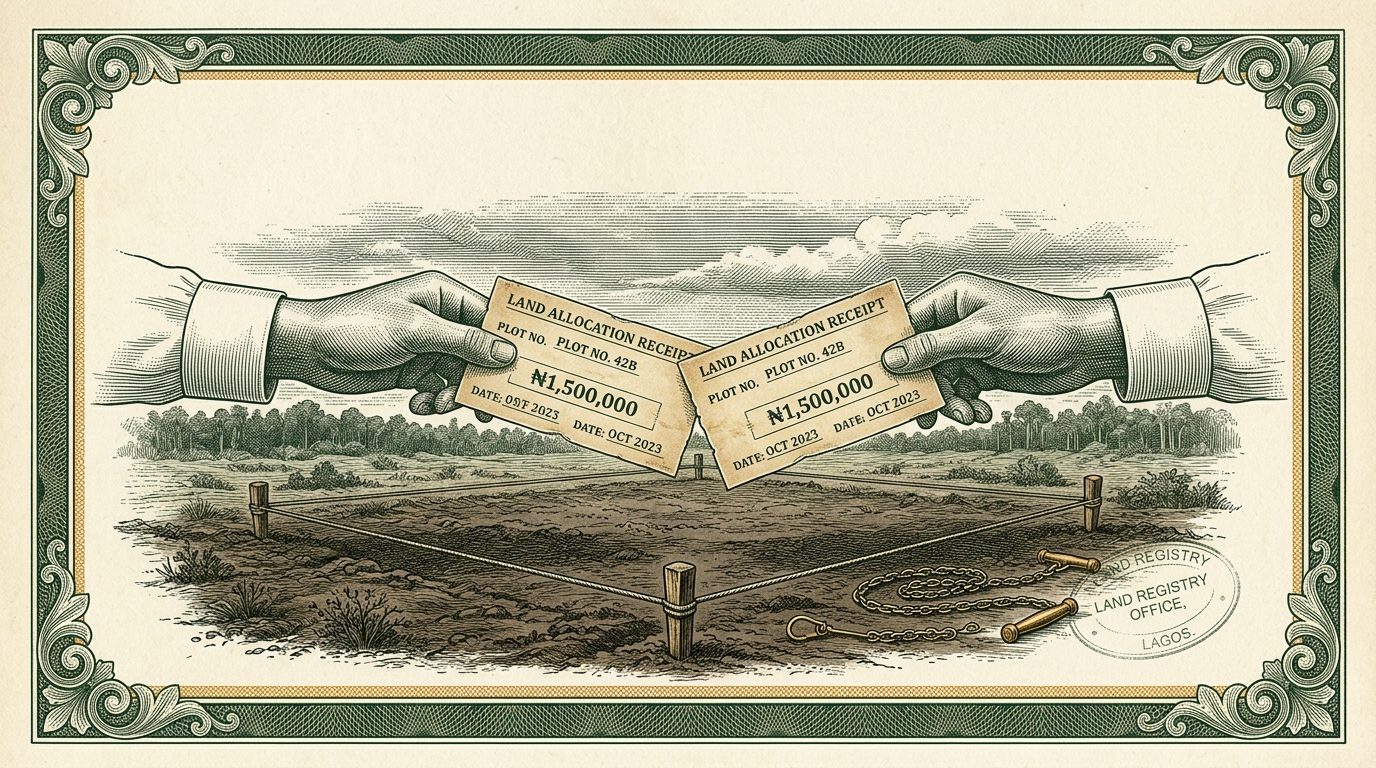
If your family sent money home for land, you already know the story's shape. A brother, an uncle, a church member's cousin knew of a plot. The photos came back on WhatsApp: a cleared rectangle of red earth, four wooden pegs, a length of string, and beyond it the green of somebody else's cassava. The receipt followed, a careful document with a plot number, a date, an amount in naira, and two signatures. Then the updates slowed. The foundation was always about to be dug. And one December, home for the weddings, the family drove out to see it, and found another family's blocks already standing inside the same pegs, and another receipt, just as careful, in another hand.
That scene is so common it barely counts as news inside a Nigerian family. It is the plot in Ibeju-Lekki, in Mowe, in Epe, bought from abroad and lost from abroad. What makes it worth reading closely is not that it happens. It is that the two families can both be holding genuine paper, both have paid in full, and both be telling the truth, and the law still hands the land to only one of them. Which one is decided by something most buyers have never been told to look for.
The receipt proves you paid. Only the upper rungs prove you own.
Start with the ground rule, because everything else sits on it. Since 29 March 1978, the Land Use Act has vested all land in each Nigerian state in the state governor, to hold in trust for the people. Nobody in Nigeria owns land outright the way the word is used in London or New York. What a buyer can hold is a right of occupancy, a long, registered permission to use a defined piece of the governor's trust. The document that evidences that right is the Certificate of Occupancy, the C of O. Every paper in a Nigerian land purchase is, in the end, an argument about that right.
So the papers form a ladder, and a buyer's safety depends on which rung they are standing on. At the bottom is the receipt: proof that money moved, and nothing more. Above it sits the deed of assignment, the document that records the transfer of the seller's interest to the buyer. Above that is the step almost nobody abroad is told about: under section 22 of the same 1978 Act, that transfer is not complete without the Governor's Consent, and section 26 makes a transfer without it null and void. And above all of it is registration at the state land registry, the public record that tells the next stranger the land is already spoken for. The receipt proves you paid. Only the upper rungs prove you own.
Here is where the double sale becomes possible. A seller, or a family that has already sold once, sells the same plot again to a second buyer who pays first but never climbs the ladder. The first buyer, slower but careful, obtains the deed, secures the Governor's Consent, and registers. The Supreme Court of Nigeria has had to answer exactly this question. In Afolarin Adenle v. Folarin Olude, decided in 2002, one Ikeja plot had been sold by the same family to two purchasers, each side holding its own receipts and deeds. The court's reasoning settled the pattern that still governs: where one buyer has perfected the legal title, the consent and the registration, that buyer beats the one who merely paid earlier and stopped at a receipt. First to pay is not first in law. First to perfect is.
Lagos decided the old way of settling this, thugs and locked gates and a family showing up to find their fence pulled down, was itself the problem. On 15 August 2016 Governor Akinwunmi Ambode signed the Lagos State Properties Protection Law. Its long title says it plainly: a law to prohibit forceful entry and illegal occupation, and violent and fraudulent conduct, in relation to landed property. It made it a crime to use force to take over land, to sell land without valid title, and, in its section 8, to sell the same property to more than one purchaser. The state was not pretending the double sale was new. It was announcing that it was now a criminal act, not a family dispute.
And still the receipts multiply, because the law changed the penalty, not the process. Ten years on, Businessday's editorial board was writing this August about what it called the great real estate heist: thousands of Nigerians holding allocation letters for land they may never lawfully own, estates sold from glossy brochures before a single approval existed, and multiple allocations of the same ground. The machinery the paper described is the one your family met: land under government acquisition, or with an unresolved family title, marketed and sold before the paperwork that would expose it was ever done. A law against the fraud does not help a buyer who never reaches the rung of the ladder where the fraud would show.
The villages have their own version, and it has a name most Nigerians know before they can spell it. Omo onile, the children of the soil, the land-owning families and the youths who collect for them. The pattern is a toll at every stage: a levy to clear, a levy to dig the foundation, the payment they call owo foundation, another to roof, another to fence. Punch's 2021 investigation found builders in Lagos groaning under exactly these demands even after the 2016 law made them criminal, and Businessday documented one buyer who paid two hundred thousand naira for the family receipt and then over one and a half million more in stage levies. The 2016 law aimed its section 11 squarely at that levy economy. The levies are still collected.
If you are reading this from abroad, you are the mark the whole system is built around. Distance is the vulnerability. You cannot stand on the plot on a Tuesday, so you buy on photographs, on a video call, on trust. Lagos State's own Office of Diaspora Affairs said as much this August, when its head, Jermaine Sanwo-Olu, set out six rules for buying land in Lagos from overseas and named the traps out loud: diaspora buyers are quoted an explicit diaspora rate, pressured with manufactured urgency, and encouraged to let one trusted person both find the property and hold the legal power to act for them, the exact arrangement under which the checks collapse. When the state's own diaspora office publishes a guide to not being robbed, it is telling you how often the robbery succeeds.
The same official advice, stripped of its polite framing, is a description of the ladder climbed in the right order, and it is worth stating as plainly as the law allows. Use two different people: one to find and negotiate, one holding a properly drafted power of attorney, never the same hands for both. Retain an independent lawyer and a registered estate surveyor before you fall in love with a plot, because after attachment they have no incentive left to warn you. Pay only by bank transfer, in stages tied to legal milestones, never cash, never ahead of the milestone. Run a search at the land registry before money moves, to see whether the plot is already registered to someone else or sits inside government acquisition. And when the seller is a community or a family, ask the question that separates safe land from a trap: has this land been excised and gazetted. Excision is the state formally releasing a defined parcel back to a community, and only once that release is published in the official gazette, and a surveyor has charted your specific plot inside it, does community land stop being government land.
None of this is a promise that careful buyers are safe. A plot can be excised and still disputed, a gazette can be forged, and a registry search is only as honest as the registry. It is also not an argument that land back home is a bad idea; for a great many families it is the point of the whole japa. What it is, is the reason this site keeps a simple rule about money sent home: the danger in Nigerian land is rarely the land. It is the paper, and which rung of it you were sold. The family that lost the plot to another family's blocks did not buy a bad piece of earth. They bought a receipt, and stopped there, and the receipt was never the thing that decides.
Sources
11 sources
- Land Use Act 1978: land vested in the state governor in trust, section 22 Governor's Consent, section 26 unconsented transfer null and void. FAOLEX, official consolidated text, Laws of the Federation of Nigeria Statute commenced 29 Mar 1978. Accessed 21 Sep 2026.
- Who owns land in Nigeria: freehold abolished, the C of O, and the registration of deeds. Africa Check Published 23 Nov 2015. Accessed 21 Sep 2026.
- Ambode signs the Lagos State Properties Protection Law, 2016. The Nation Published 15 Aug 2016. Accessed 21 Sep 2026.
- Section-by-section of the 2016 law: sale without valid title, sale to multiple purchasers, and the owo foundation levy ban. LawPavilion Blog Published 28 Sep 2016. Accessed 21 Sep 2026.
- Afolarin Adenle v. Folarin Olude (2002): one Ikeja plot sold twice, and why perfected title beats earlier payment. LawGlobal Hub, Supreme Court judgment Judgment of the Supreme Court of Nigeria, 2002. Accessed 21 Sep 2026.
- Omo onile stage levies and the yoke on Lagos builders after the 2016 law. Punch Published 10 Apr 2021. Accessed 21 Sep 2026.
- The omo onile menace in Lagos and Ogun, including a two hundred thousand naira receipt followed by over one and a half million in levies. Businessday By Chuka Uroko, 8 Oct 2023. Accessed 21 Sep 2026.
- The great real estate heist: allocation letters that may never be lawful, and multiple allocations of the same ground. Businessday editorial board Published 10 Aug 2026. Accessed 21 Sep 2026.
- Six rules for buying land in Lagos from abroad: diaspora rates, manufactured urgency, separated roles, registry search. Businessday By Ngozi Ekugo, reporting Lagos State diaspora affairs official Jermaine Sanwo-Olu, 4 Aug 2026. Accessed 21 Sep 2026.
- Excision, gazette and the C of O: when community land stops being government-acquired. Chaman Law Firm Published 9 Oct 2025. Accessed 21 Sep 2026.
- Title perfection in Nigeria: the C of O, deed of assignment, Governor's Consent and registration chain. Enebeli and Partners Legal Published 17 Jul 2026. Accessed 21 Sep 2026.
Spotted something wrong? Report a correction. Every fix is logged in the open corrections record.