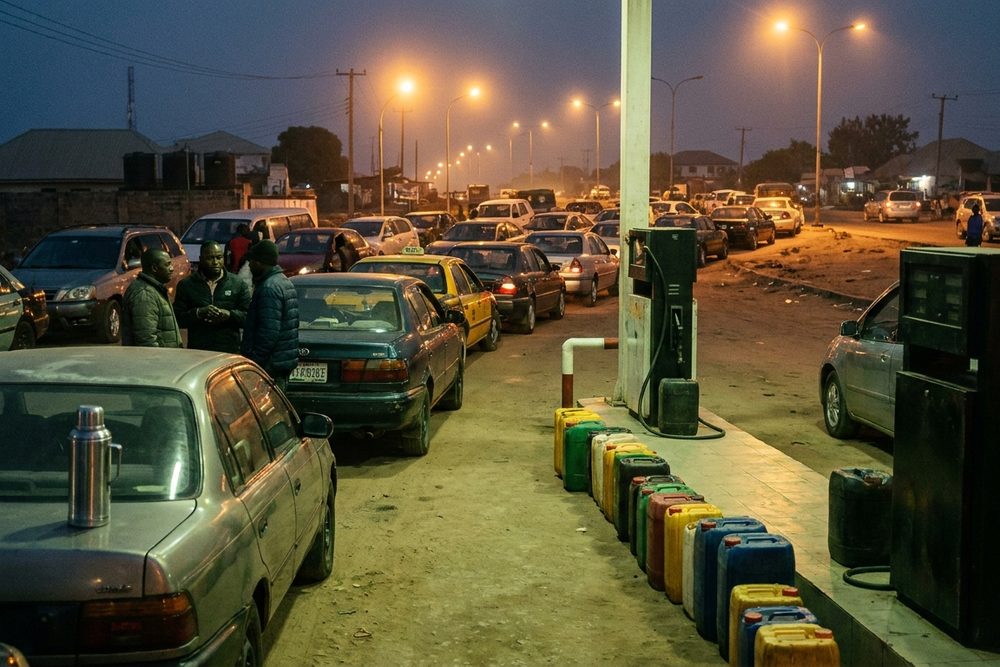
If you are Nigerian, you know the queue without being told which one. Not the bank queue, not the embassy queue. The fuel queue. The one that starts before dawn, jerrycans lined on the boot of a Corolla, a thermos of tea passing hand to hand while the station's pump stays stubbornly off. The one where a tanker sighting moved through a neighbourhood like news of a relative landing at the airport. The one where, if NEPA took the light the night before, you were not just queuing for the car. You were queuing for the generator that was the real power company.
That queue was never really about petrol. It was about a promise that kept being made and kept not being kept: that a country which pumped over two million barrels of crude a day would one day refine its own. The four state refineries at Port Harcourt, Warri and Kaduna were built for exactly that, with a combined capacity of about 445,000 barrels a day, nearly twice what the country then needed. By the 1990s they barely worked. The Washington Post wrote in March 1998 that Nigeria, one of the world's biggest oil producers, was plagued and sometimes virtually paralysed by a desperate shortage of petrol. The refineries, the paper noted, like the railways and the telephones, barely functioned.
The queue has become a counter.
The decades after read like a single repeating sentence. A government would announce a turnaround maintenance, the TAM. Money would be voted, a contractor named, a ceremony held. For a few months the stacks would smoke, and then the plant would go quiet again. Daily Trust counted 264 billion naira spent on TAM between 1999 and 2016 alone, with refineries that, whenever they managed to resume, hardly worked up to 90 days before shutting down. Punch's editorial board, writing in May 2026 after yet another revival memorandum, put the cumulative figure in the tens of billions of dollars and called the refineries a costly national albatross. Former President Olusegun Obasanjo, who had tried to hand them to Shell and been refused, said in 2026 they would never work again. In 2007 he had sold three of them to a consortium led by Aliko Dangote and Femi Otedola for 750 million dollars. His successor reversed the sale within months, and Nigeria paid back over a billion dollars for breaking the contract. The queue stayed.
So when a single private refinery in the Lekki Free Zone actually reached its full capacity, it landed on a country that had stopped believing the sentence could end any other way. The Dangote refinery is a 650,000 barrel a day plant, bigger than all four state refineries combined, and it was re-rated to 700,000 barrels a day this year. It is the reason petrol queues have loosened their grip. It is also, as of this morning, something no Nigerian refinery has ever been: a thing you can own a slice of.
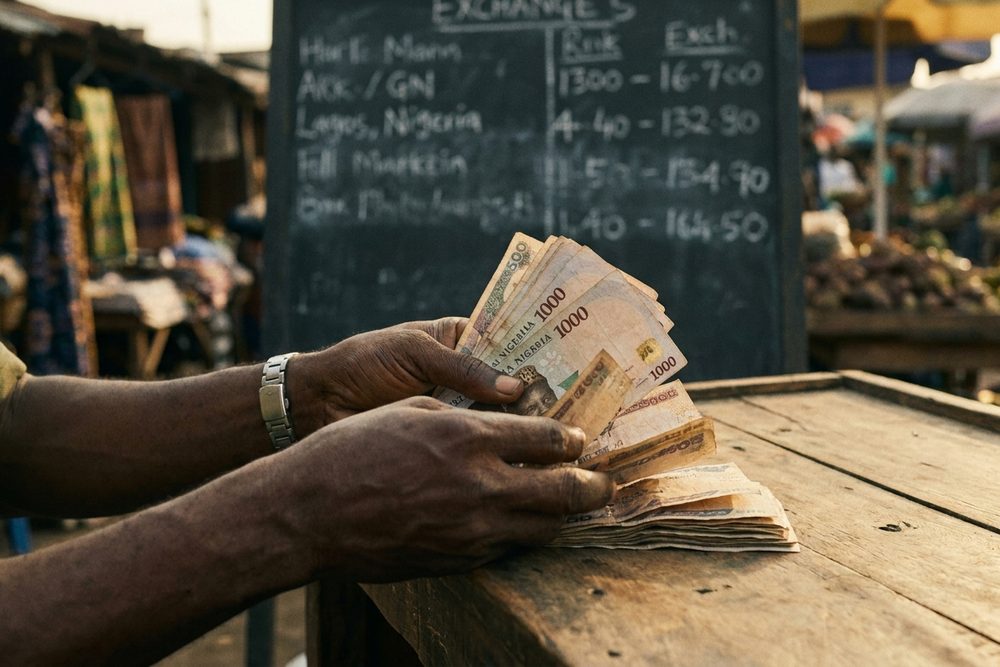
Today, 14 September 2026, the initial public offering of Dangote Petroleum Refinery and Petrochemicals opens on the Nigerian Exchange. The terms, per the prospectus reported by Businessday, Punch and Reuters, are these: 4.1 billion new ordinary shares at 525 naira each, a minimum subscription of 10 shares, or 5,250 naira, with the offer running to 13 October 2026. If fully subscribed it raises about 2.15 trillion naira, roughly 1.6 billion dollars, which Reuters calls Africa's largest share sale yet. Aliko Dangote sounded the opening gong on the NGX floor in Lagos. Vanguard noted it is the first refinery ever offered for public subscription in the Exchange's 66-year history.
Here is the part the headline does not carry. Those 4.1 billion shares are a small slice of the whole. The refinery has 120.13 billion ordinary shares in issue, so the public offer is about 3.3 percent of the company, and after a Mauritian investment vehicle takes up a committed 400 million dollars of it, the slice left for everyone else is smaller still. Dangote himself keeps about 84 percent. The valuation the offer implies is about 65 trillion naira, or some 47 billion dollars, which would make it the largest company on the NGX by a distance and, as Businessday calculated, big enough to push the whole exchange's market capitalisation up by more than a third. A fund that tracks the main index would, in time, likely have to hold it.
A listing this size has a way of making people feel they must be in the queue on the first day. The honest research says two things at once, and both deserve to be said plainly. The first is that this is a real industrial asset, the first of its kind, reaching the public market of the country that queued for four decades because nothing like it worked. The second is that a refinery is, in the end, one asset. Businessday's editorial board valued the offer against global refiners and found it priced at a premium to Marathon and Valero, a premium that only holds if margins stay high, if the planned doubling to 1.4 million barrels a day by 2029 is delivered, and if a generous tax treatment does not roll off in 2028. Daily Trust's reading of the prospectus was blunter: a single facility means a single point of failure, and concentration like that usually earns a discount, not a premium. None of that is an argument for or against a share. It is an argument that the question worth asking is not whether it is Dangote, but what the earnings are and what you are paying for them.
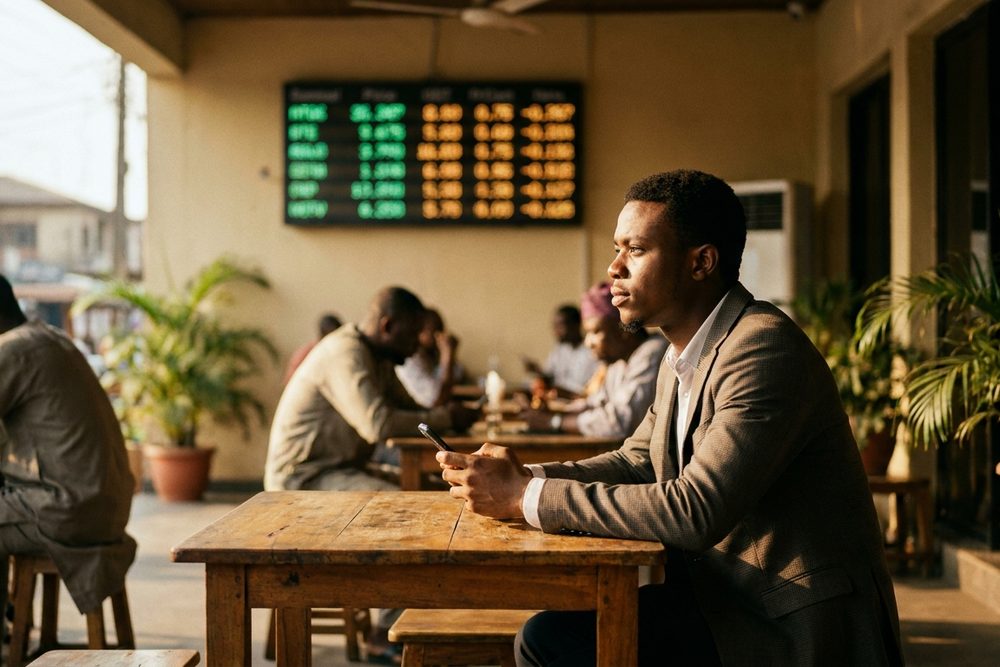
The queue taught a generation of Nigerians a hard lesson about single points of failure. One terminal, one pipeline, one set of refineries, and the whole country waited. The counter opening today is a different thing entirely, a company choosing to be counted, audited and priced in public, on the exchange of the country that built it. Whether any one person buys is their own decision, and this page has no view on it. What is worth marking, on the day, is quieter. For the first time, the refinery is not only something Nigeria waits on. It is something Nigeria can read about, question, and measure, in the open. The queue has become a counter. That, after forty years, is the news.
Sources
9 sources
- Dangote launches Africa's largest share sale with the refinery IPO. Reuters Published 14 Sep 2026. Accessed 14 Sep 2026.
- Dangote refinery begins the 2.15 trillion naira share offer, terms and dates. Punch By Dare Olawin, 14 Sep 2026. Accessed 14 Sep 2026.
- First refinery offered for public subscription in the NGX's 66-year history. Vanguard Published 14 Sep 2026. Accessed 14 Sep 2026.
- Prospectus detail: 4.1 billion shares of 120.13 billion in issue, about 3.3 percent free float, Mauritius vehicle's 400 million dollar commitment. Businessday By Abubakar Ibrahim, 8 Sep 2026. Accessed 14 Sep 2026.
- Valuation premium over global refiners, the 2028 tax change, and the 1.4 million barrel expansion risk. Businessday editorial board Published 11 Sep 2026. Accessed 14 Sep 2026.
- Single-asset concentration risk and the case for reading the prospectus. Daily Trust By Tosin Adeoti, 10 Sep 2026. Accessed 14 Sep 2026.
- Nigeria's four state refineries, 445,000 barrels a day, and the 1998 petrol shortage. The Washington Post By James Rupert, 30 Mar 1998. Accessed 14 Sep 2026.
- 264 billion naira spent on refinery maintenance between 1999 and 2016, and the 90-day failure cycle. Daily Trust By Daniel Adugbo, 15 Sep 2016. Accessed 14 Sep 2026.
- The state refineries as a costly national albatross: Obasanjo's 2007 sale, its reversal, and decades of failed turnarounds. Punch editorial board Published 11 May 2026. Accessed 14 Sep 2026.
Spotted something wrong? Report a correction. Every fix is logged in the open corrections record.