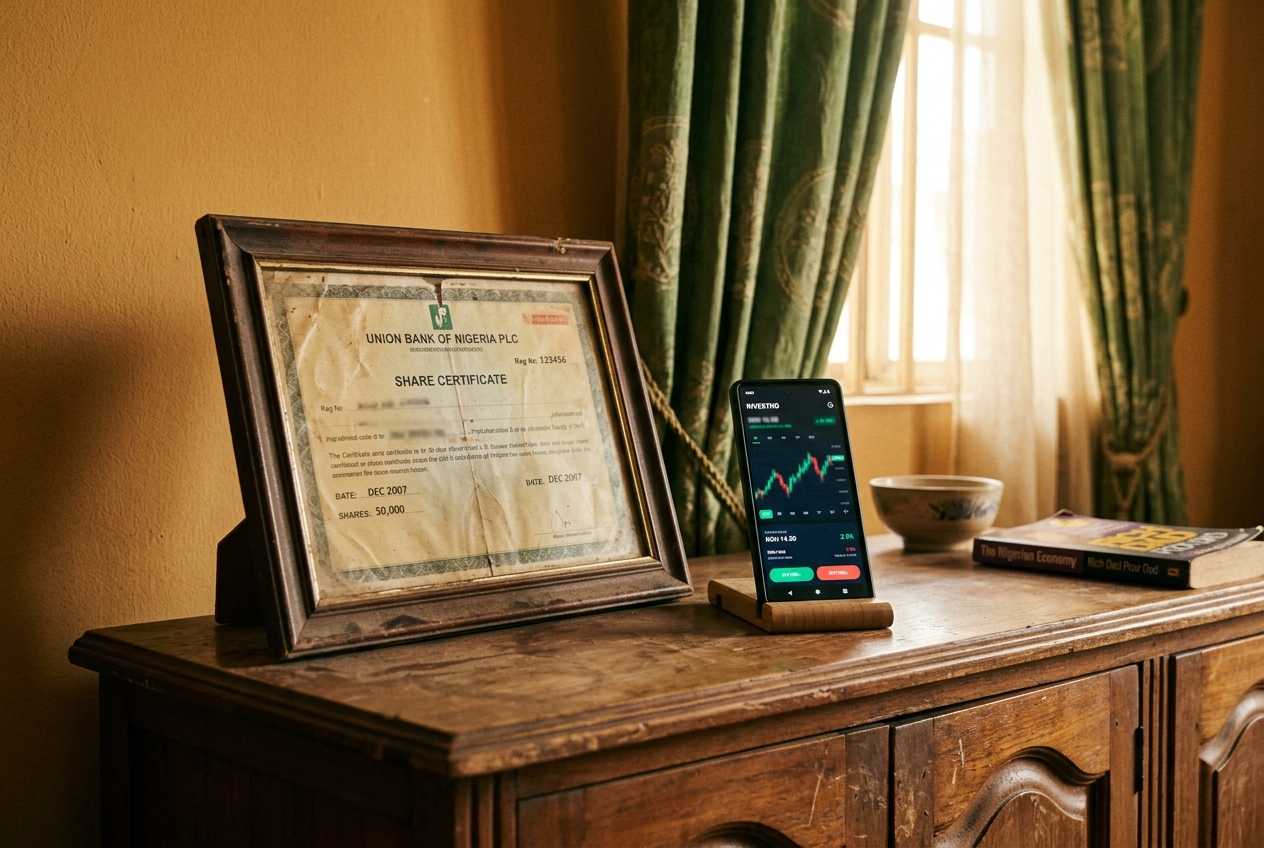
There is a particular kind of silence that settled into many Nigerian homes after 2008. It was the silence around the share certificates, the ones bought in the public offer rush of 2004 to 2007, when the banks were recapitalising and it felt like the whole country had become shareholders. The silence was around how much was lost. Market women who had bought stocks. Taxi drivers who had discussed IPOs. In some cases, people who had sold property to buy shares, watching it all fall through 2008 and into 2009 until the All Share Index had lost roughly 70 percent of its value. TechCabal, reporting this month on the new generation of investors, put the figure at about 6.96 trillion naira wiped out in nine months after a four-year bull run. For plenty of families, the lesson was simple and lasting: the stock market is where money goes to die.
Which is what makes the numbers coming out of the Nigerian Exchange in 2026 read like a different country talking. Retail investors, ordinary individuals rather than pension funds or institutions, traded 2.86 trillion naira of equities between January and May this year, up 138.76 percent on the same period in 2025, and now account for 36.22 percent of everything traded on the exchange. Bamboo, the app that added Nigerian stocks only in May 2024, said it became the exchange's largest broker by weighted market share in April 2026 after executing 542,582 trades in a single month. The company says 73 percent of its users are between 18 and 34 years old. The people buying are, in large part, the children of the people who were burned.
It was whether they had bet money they could not afford to lose, in one direction, all at once.
What 2008 actually did
It is worth being precise about what the 2008 crash was, because the memory has blurred into a general warning. The All Share Index peaked at 66,371.20 points on 5 March 2008, at the top of a run powered by bank recapitalisation, the 2004 consolidation that took 89 banks down to 25, and a flood of first-time investors, many of them borrowing from banks to buy the very bank shares that were being offered. When the global financial crisis hit at the same time the local bubble burst, the index fell for over a year, bottoming out around 70 percent below the peak by early 2009. The wound lasted. The index did not climb back above that March 2008 level for the first time until 29 August 2023, more than fifteen years later. AMCON, the body created in 2010 to absorb the banks' bad debts, took on an entire first tranche made up of margin loans, the borrow-to-buy-shares money that had detonated.
What is different in 2026
The boom happening now is not a replay of that one, and the differences are specific. The first is how people are buying. The 2004 to 2007 rush was lump sums into public offers, often with borrowed money. The 2026 pattern, as TechCabal documented it through named first-person accounts, is small fixed amounts every month: a Lagos communications professional putting at least 200,000 naira monthly into Bamboo out of an 800,000 naira salary, an HR professional putting 20,000 naira a month into US mutual funds and 20,000 into Nigerian equities, a research analyst who was in primary school during the crash now putting at least 50,000 naira monthly into Meristem and Cowrywise. This is a savings habit with a market attached, not a one-time bet. The second difference is the apps themselves: NGX Invest launched in 2024 to move public offers online, and the incumbent brokers, Stanbic IBTC with BluNest and Meristem with Meritrade, have built their own app-first products to compete with the likes of Bamboo, Trove, Risevest and Cowrywise. Access is no longer the gate it was.
What is not different
The honest part is what has not changed. A rising market makes everyone feel informed, and this market has been rising hard: the All Share Index gained 51.19 percent in 2025 and added another 47.43 percent in the first half of 2026, with individual stocks returning 30, 50, even over 100 percent in a year, as one CSL Stockbrokers analyst put it. That kind of run teaches a dangerous lesson, that buying the popular names on the app is a strategy, right up until it is not. Some of the new investors interviewed admitted they pick from the big names they recognise on the app and build a routine. A routine is genuinely useful. But it is not the same as knowing what you hold, and a concentrated bet on a few bank stocks going up is still a concentrated bet on a few bank stocks. The 2008 generation had a phrase for the same feeling: this time is different.
So what should the children of 2008 actually take from their parents' silence? Not that the market is a scam, because it is not, and the last fifteen years of recovery prove it is not. And not that it is safe now, because the mechanism that made 2008 so damaging, ordinary people concentrating money they could not afford to lose into a rising market and calling it investing, is a mechanism that exists in every boom, including this one. The useful lesson is narrower and harder: the difference between the people who were wiped out and the people who were merely bruised was not cleverness. It was whether they had bet money they could not afford to lose, in one direction, all at once. The monthly habit, the small amounts, the regulated apps, the fact that you can now start with a few thousand naira instead of a lump sum, all of that is genuinely better. It lowers the cost of being wrong. It does not remove the possibility.
If you are one of the children buying now, you are not wrong to be there. You are participating in something your parents' generation built and then got hurt by, and you are doing it with better tools and more information than they had. Just do not confuse a market that has been kind for two years with a market that has become safe. The silence in those homes after 2008 was not about the market being rigged. It was about money that could not be afforded to be lost, being lost. That specific mistake is still available, on any app, at any time. Avoiding it is the whole job.
Sources
- Their parents lost fortunes. They're buying Nigerian stocks anyway. TechCabal By Temitayo Jaiyeola, 18 Jul 2026. Accessed 28 Jul 2026.
- Driven by mobile apps, Nigerian retail investors traded 2.07 billion dollars in five months. TechCabal By Temitayo Jaiyeola, 25 Jun 2026, citing NGX data. Accessed 28 Jul 2026.
- NGX All Share Index surpasses 68,000 mark, first time above the 2008 record. BusinessDay 4 Sep 2023. Accessed 28 Jul 2026.
- The crash of the Nigerian stock market: causes and consequences. Yale Journal of Financial Crises Case study, revised 23 Jun 2021. Accessed 28 Jul 2026.
- Nigerian equities All Share Index hits all-time high of 65,669.29 points. Nairametrics 12 Jul 2023. Accessed 28 Jul 2026.
- NGX All Share Index ends first half of 2026 up 47.43 percent. Nairametrics H1 2026 close, 1 Jul 2026. Accessed 28 Jul 2026.
- NGX market capitalisation crosses 100 trillion naira. Nigerian Exchange Group Crossed 5 Jan 2026. Accessed 28 Jul 2026.
- NGX Invest, the e-offering platform for public offers, goes live. Nigerian Exchange Group Launched 12 Jul 2024. Accessed 28 Jul 2026.
- Asset Management Corporation of Nigeria Act, created to absorb bad bank debts including margin loans. AMCON Act signed 19 Jul 2010. Accessed 28 Jul 2026.
- Nigeria's 2004 banking consolidation, 89 banks to 25. Central Bank of Nigeria Soludo consolidation, completed end 2005. Accessed 28 Jul 2026.
Spotted something wrong? Report a correction. Every fix is logged in the open corrections record.