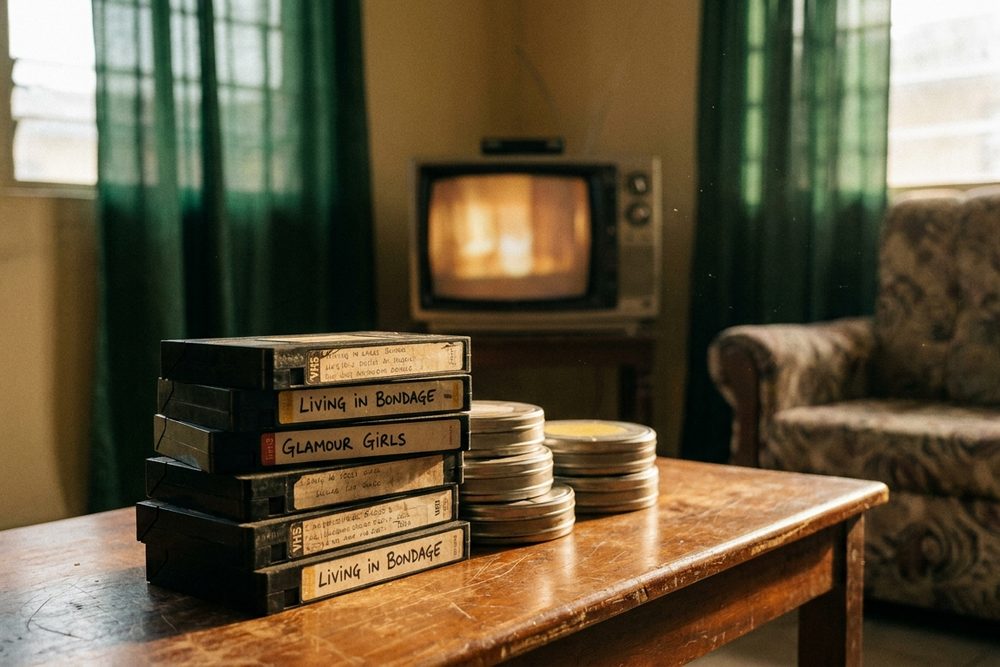
If you grew up in Nigeria in the 1990s or 2000s, you already know the room. A parlour with the curtains drawn against the afternoon heat, a television with the colour slightly wrong, and a cassette that had been watched so many times the picture rolled. Somebody's cousin controlled the video machine. Somebody's mother announced one more film and then everybody should go home. And when NEPA took the light at the exact moment Andy Okeke was about to face what he had done, the whole room shouted at once, as if the power company had timed it.
If you grew up abroad, the memory has a different shape but the same films inside it. The African shop that kept new titles behind the counter. The auntie who carried cassettes home in her luggage, wrapped inside wrappers. The burned discs passed around after church. For plenty of diaspora children, Nollywood was where they heard Igbo, Yoruba and pidgin spoken at full speed, in full colour, by people who looked like the family in the photo albums.
The cassette was the product. The film turned out to be the property.
All of it traces back to one specific, dated business decision. In 1992, Kenneth Nnebue, a Lagos trader whose company NEK Video Links imported blank video cassettes, was sitting on stock he could not sell. A trained filmmaker named Okechukwu Ogunjiofor brought him a story. Nnebue put up the money, about 150,000 naira, and the result was Living in Bondage, shot in Igbo on a video camera and released straight to cassette in September 1992. It was not made to launch an industry. It was made to move unsold cassettes. By the producers' own telling it took in some twenty million naira in its first month, and it launched the industry anyway.
What followed filled two decades of parlours and video clubs. Issakaba, the Bakassi Boys vigilante saga led by Sam Dede, which The Conversation this month called one of Nollywood's defining films. Osuofia in London in 2003, with Nkem Owoh carrying a whole village's expectations to London and finding the city had other plans. The Aki and Paw Paw comedies. By the time UNESCO counted, Nigeria was producing around 2,500 films a year, an output second only to India, from an industry that had started as a way to sell tape.
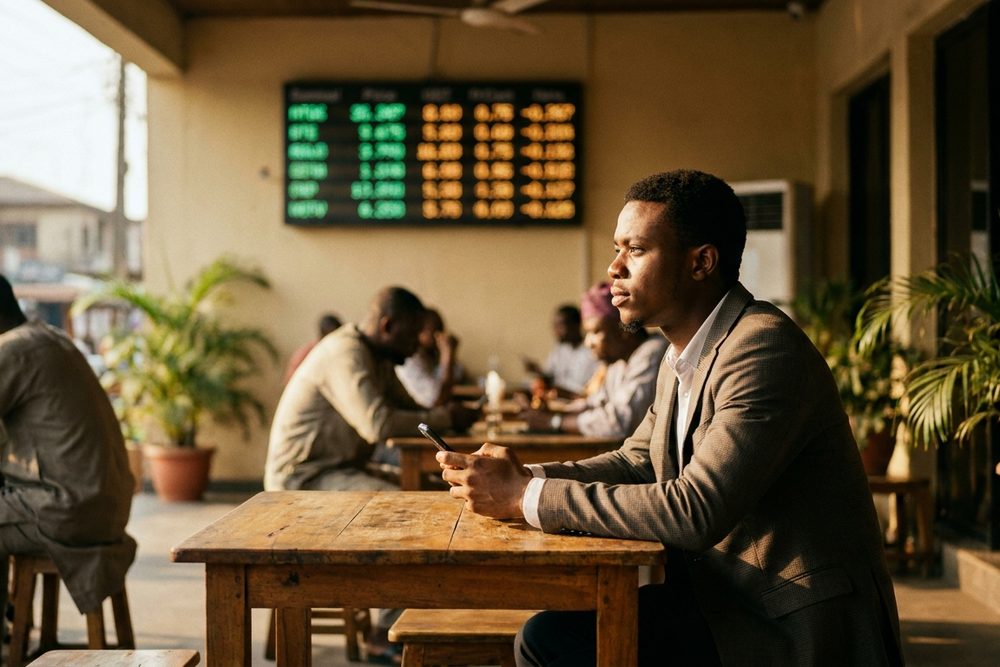
Now hold that thirty-year memory next to one number. The Nigerian Exchange in Lagos is the market where companies sell shares, small slices of ownership, to the public, and where anyone can buy them. Its list of traded companies ran to 146 names when we checked it for this piece: banks, cement makers, breweries, insurers, oil marketers. The number of film companies on that list is zero. Not small. Zero. An industry among the largest in the world by output has never placed a single company on its own country's stock market.
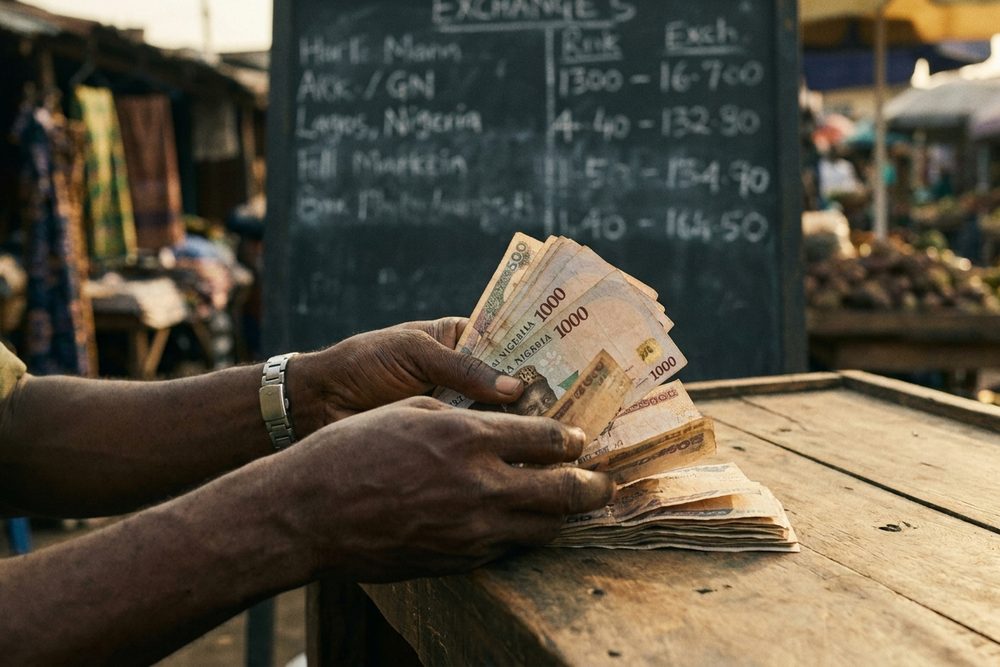
The reasons sit inside the industry's own history. Nollywood was financed the way its first film was financed: a trader's money, a marketer's money, family money, recouped in cash at Idumota, Onitsha and Aba. Money like that leaves no audited books, and a company without audited books cannot sell shares to the public, because nobody can check what it truly earns. Piracy made it worse. When most copies of a film are sold by people who never paid for it, the honest answer to the question of what the film earned is that nobody knows. A market cannot put a price on what nobody can count.
The cinema route could not carry the weight either. UNESCO counted 1,651 cinema screens on the entire African continent, and Nigeria had done well to reach 237 modern screens by 2020. Set that against 2,500 films a year and the mathematics never worked. Almost everything the industry made had to travel through channels no accountant could follow.
For a moment, streaming looked like the answer. Netflix and Amazon arrived, commissioning Nigerian originals, paying in advance, and paying in a way that could be audited. Then the money got shy. In January 2024, Amazon's Prime Video stopped commissioning new African originals altogether. By the end of that year, Nigerian filmmakers were describing cancelled Netflix projects even as the company insisted it was not leaving. Whatever streaming eventually becomes for Nollywood, the lesson of 2024 landed hard: distribution you rent can be taken back.
That is what makes this July's news read like a turn in the story. Businessday reported on the industry's pioneers taking decades-old films back to market. Mike Bamiloye is bringing Agbara Nla, the Christian classic he produced more than three decades ago, to cinemas for the first time. The 2019 sequel to Living in Bondage, made under a ten-year lease on Kenneth Nnebue's original rights, grossed over 168 million naira, and with that lease closing, the rights walk back to Nnebue worth far more than when he leased them out. A company called Play Network Studios has spent years buying the rights to classics: Rattlesnake, Nneka the Pretty Serpent, Glamour Girls, Aki and Paw Paw.
The term for what they are trading is intellectual property, and it deserves a plain definition: ownership of a story, a film, a character, in the same way a person owns land. Nigerian law protects a film's copyright for fifty years, and inside that window the owner decides who may remake it, stream it or return it to cinemas, and collects when they do. The films you watched in that parlour were never just an afternoon's entertainment. The cassette was the product. The film turned out to be the property.
Here is what none of this means. It does not mean there is a Nollywood share to buy. There is not. The count on the Exchange is still zero, and whether any film company ever lists is an open question that turns on exactly the things that kept them off: audited books and revenue somebody can prove. It also does not mean old films are a sure thing. Some re-releases will find their audience and some will not, and anyone who claims certainty about which is selling something. What changed in July 2026 is quieter and more interesting. The industry that made the films you grew up on has started treating its own past as an asset it can prove, price and defend. That distance, from unthinkable to merely unproven, is the story.
The video this piece accompanies walks through the full argument, from the 2,500 films to the empty exchange listing to the July wave of re-releases. This page exists for the part the research had to compress: the parlour, the video club queue, the auntie's luggage. You were not just watching films. You were watching property being created, one cassette at a time, decades before anyone thought to call it that.
Sources
- Kenneth Nnebue, the unsold cassettes, and the making of Living in Bondage (1992). The African Courier Published 7 Dec 2017. Accessed 19 Jul 2026.
- Nollywood pioneers returning decades-old films to market, and who owns the classic rights. Businessday By Anthony Udugba, 10 Jul 2026. Accessed 19 Jul 2026.
- Nigeria produces around 2,500 films a year. UNESCO Published 18 Jan 2022. Accessed 19 Jul 2026.
- Cinema screens across Africa, including Nigeria's 237 modern screens in 2020. UNESCO, The African Film Industry report Report published 2021. Accessed 19 Jul 2026.
- Listed companies on the Nigerian Exchange, the full equities list, no film company among them. Nigerian Exchange Group 146 equity listings at the time of writing. Accessed 19 Jul 2026.
- Amazon Prime Video stops commissioning African originals. TechCrunch By Annie Njanja and Tage Kene-Okafor, 18 Jan 2024. Accessed 19 Jul 2026.
- Netflix cutting Nigerian productions while denying an exit. Semafor Published 5 Dec 2024. Accessed 19 Jul 2026.
- Issakaba and its place in Nollywood memory. The Conversation By Mark Tekena, 16 Jul 2026. Accessed 19 Jul 2026.
- Osuofia in London (2003), starring Nkem Owoh. Lexicon of Global Melodrama, transcript Verlag Chapter by Uchenna Onuzulike, 2022. Accessed 19 Jul 2026.
Spotted something wrong? Report a correction. Every fix is logged in the open corrections record.